Gator EFX vs Gator FX3: Which Hard Fold Cover Fits Your Truck?
Choosing between the Gator EFX and the Gator FX3 means understanding how panel design affects everyday use. Both are hard fold tonneau covers built from the same aluminum core and powder-coated finish, but they handle bed access and cargo differently.
The EFX uses a two-panel design that opens from the cab end, while the FX3 splits into three panels with dual-position folding. We built both models to solve different problems—the EFX prioritizes fast full-bed access, and the FX3 balances partial access with a lower stowed profile. This guide walks through the differences that matter when you're standing in your driveway deciding which one belongs on your truck.

Panel Count and How You Actually Open the Bed
The EFX folds in half—two panels hinged at the center. You release the tailgate clamps, lift from the rear, and the entire cover folds forward against the cab in one motion.
The FX3 divides the bed into thirds. You can open just the rear panel for quick cargo access, fold two panels to reach mid-bed, or stack all three forward for full clearance. Each panel locks independently, so you’re not committed to opening the whole cover every time you need something from the back.
This changes how you use the truck daily. If you haul full sheets of plywood or need the entire bed open most days, the EFX’s single-motion design is faster. If you grab tools from the rear or load smaller cargo without fully exposing the bed, the FX3’s sectional access keeps the rest of your cargo covered and saves you from re-securing the entire cover.
Weight Capacity and What You Can Actually Stack On Top
Both covers support distributed loads, but the panel span affects capacity. The EFX’s two-panel design handles up to 400 pounds evenly distributed across the bed. The wider unsupported span between hinge points means the aluminum skin flexes slightly under concentrated weight.
The FX3’s three-panel layout tightens the support intervals and raises capacity to 500 pounds distributed. The extra hinge at mid-bed reduces flex, so heavier gear stacks more securely without bowing the panels.
For reference, our Gator Trio extends this principle further with four panels and reinforced cross-bracing for extreme-duty applications. If you routinely carry rooftop cargo on the cover itself—not just inside the bed—the FX3’s tighter hinge spacing handles that load pattern better than the EFX.
Installation Differences and Clamp Adjustments
Both models use the same clamp-on rail system with no drilling required. The EFX mounts in roughly 20 minutes because you’re aligning two panels and six clamps total.
The FX3 adds a third panel and requires positioning the mid-bed hinge during install. You’ll spend closer to 30 minutes, and you need to check alignment at three fold points instead of one. The manual includes shim spacers to level panels if your bed rails aren’t perfectly parallel.
Neither cover requires permanent modification, so switching between the EFX and FX3 later is possible if your hauling needs change. The clamp positions differ slightly between models, but both use the same bolt pattern and rail extrusion.

Stowed Height and Rear Window Clearance
When folded open, the EFX stacks two thick panels against the cab. This creates a 9-inch profile that may block part of your rear window view depending on cab height.
The FX3 stacks three thinner panels into a 7.5-inch profile. The extra fold point compresses the stack lower, preserving more rear visibility when the cover is open.
This matters most on short-bed trucks where the folded stack sits closer to the cab. If you frequently drive with the cover open and rely on your rear window for visibility, measure your cab-to-bed gap and compare it to the stowed heights. The FX3’s lower profile clears more sight lines.
Weather Sealing and How Panel Joints Perform
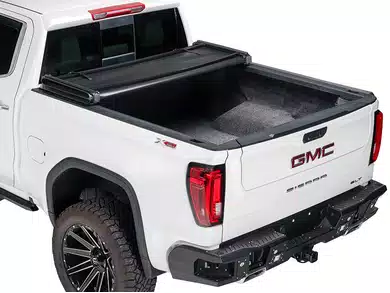
Both covers use EPDM rubber seals along the perimeter rails and tailgate. The EFX has one center hinge joint where panels meet, and that joint includes an overlapping flange with a compression seal.
The FX3 introduces two hinge joints—one at the first third and one at two-thirds. Each joint uses the same overlap-and-seal design, but you’re adding one more potential entry point for water.
In practice, both models shed rain and snow without pooling. The tri-fold geometry used across our hard fold lineup angles water toward the tailgate rather than letting it collect at hinge points. The FX3’s extra joint hasn’t created leakage issues in field testing, but it does mean one more seal to inspect during maintenance.
Choosing Between EFX and FX3 for Your Truck
The EFX suits trucks where you need the entire bed open quickly and don’t mind sacrificing partial access. The FX3 fits daily drivers who load and unload smaller cargo frequently and want the option to expose just part of the bed.
Both covers use the same materials, finish, and rail system, so durability and weather resistance are identical. The difference is purely operational—how you open the bed and how high the cover stacks when folded. If you’re still uncertain which panel count matches your routine, consider whether you open the full bed or just the tailgate area most often. That pattern decides which hinge layout works better for your truck.
Common Questions About the EFX and FX3 Models
Yes. The FX3's three panels lock independently, so you can release and lift only the rear panel for tailgate access. This leaves the front two-thirds of the bed covered and doesn't require you to fold the entire cover forward every time.
The EFX weighs 52 pounds, and the FX3 weighs 58 pounds. The difference comes from the FX3's additional hinge assembly and reinforcement brackets, not the panel material itself. Both use the same aluminum core and finish.
The FX3 handles bed extenders more easily because you can fold just the rear panel without disturbing the full-length cover. The EFX's two-panel fold requires moving the entire cover forward, which may interfere with extender mounting depending on your setup.
Yes. Both the EFX and FX3 use rotary paddle latches at the tailgate with a keyed cylinder lock. The FX3 adds slam latches at the mid-bed hinge so the second panel secures without a separate key, but the primary lock hardware is identical.
Both covers install solo. The EFX's 52-pound weight and two-panel design make it slightly easier to position alone. The FX3's extra panel and mid-bed hinge alignment benefit from a second person steadying the cover during clamp tightening, but it's not required.
Both hinges use stainless steel pins and self-lubricating bushings rated for the same cycle count. The FX3's additional hinge sees less angular stress per fold because the panel weight is distributed across more pivot points, so wear rates are comparable between models.